
David was 61 years old when he first sat down in our consultation room. He had been a keen golfer for thirty years. However, for the last two of them, his left knee had effectively ended that chapter of his life. He had tried anti-inflammatory tablets, physiotherapy, and two courses of steroid injections. Each time, the relief lasted a few weeks, then faded. His GP had mentioned a knee replacement, but David wasn’t ready. He was too young, too active, and frankly too determined to accept that as his only option.
Then he read something online about Arthrosamid. He arrived at clinic with a printout and one very direct question: “What exactly is it, and how does it work?”
It’s a question we hear all the time. And it’s a good one — because Arthrosamid is genuinely different from the other joint injections that have come before it. Once you understand what it is and what happens when it enters the knee, it becomes much easier to decide whether it might be right for you.
This article answers that question in full. No jargon, no fluff — just a clear, honest explanation of what Arthrosamid is, how it works, who it’s suitable for, and how it compares to other treatments like hyaluronic acid injections and corticosteroid jabs.
What Is Arthrosamid?
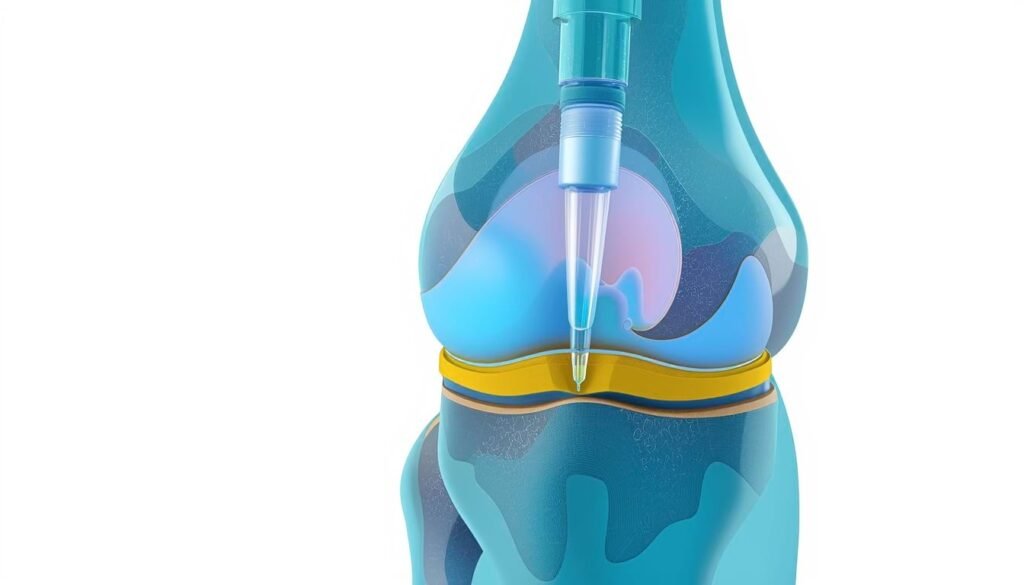
Arthrosamid is an injectable hydrogel designed specifically to treat knee joint pain. It was developed in Denmark over more than two decades of research and has been used in various medical applications since the early 2000s. More people in the UK are now using this knee injection as an alternative to surgery.
At its most basic, Arthrosamid is a soft gel — but a very specific kind of gel. It is made up of:
• 97.5% water
• 2.5% cross-linked polyacrylamide — a stable, synthetic polymer
What makes it different from other injections is the polyacrylamide inside it. It creates a strong, flexible three-dimensional structure — almost like a microscopic sponge — that is exceptionally biocompatible with human tissue. Biocompatible simply means that the body doesn’t treat it as a foreign invader; it accepts it.
Arthrosamid does not break down in the body. Other injections, like hyaluronic acid or steroid injections, are absorbed after a while, but Arthrosamid stays in the joint and keeps working.
How Does Arthrosamid Work Inside the Knee?
To understand how Arthrosamid works, it helps to understand what is going wrong inside an arthritic knee in the first place.
What Happens Inside an Arthritic Knee
In a healthy knee, the ends of the bones are covered in smooth cartilage, and the joint is filled with synovial fluid — a natural lubricant that reduces friction and absorbs shock. The inner surface of the joint is lined by the synovial membrane, which produces and regulates this fluid.
In osteoarthritis, the cartilage slowly breaks down. The synovial fluid becomes thinner and no longer cushions the joint properly. Bone starts to rub against bone, leading to swelling, pain, and stiffness. The synovial membrane also becomes sore and inflamed, which keeps the cycle of pain going.
This is the environment Arthrosamid is designed to work in.
What Arthrosamid Does When Injected

Arthrosamid is injected directly into the knee joint — specifically into the space inside the joint capsule, known as the intra-articular space. The injection is always performed under real-time ultrasound guidance by a trained specialist. This ensures the gel is placed precisely where it needs to be.
Once inside the joint, something remarkable happens. Rather than simply floating in the joint fluid the way hyaluronic acid does, Arthrosamid begins to integrate with the synovial membrane — the lining of the joint itself. Over the following weeks, the hydrogel bonds with the soft tissue of the synovium and becomes part of the joint structure.
This integration process is what gives Arthrosamid its unique properties. Once embedded in the joint lining, it:
• Acts as a permanent cushioning layer, absorbing impact and reducing bone-on-bone friction
• Creates a physical barrier that helps reduce inflammatory signals within the joint
• Improves the viscosity and lubrication of the synovial fluid around it
• Restores the elastic and shock-absorbing properties that osteoarthritis has degraded
Because it integrates rather than simply floats, and because it does not break down, Arthrosamid can continue providing these benefits for a considerable length of time. Clinical studies have demonstrated sustained, significant improvements in pain, stiffness, and joint function for up to three years after a single injection — and ongoing research suggests the benefits may extend well beyond that in many patients.
What Does the Arthrosamid Injection Procedure Involve?
One of the reasons Arthrosamid has become popular is that the procedure itself is relatively quick and straightforward — especially when compared to the alternative of knee replacement surgery.
Here is what to expect at a clinic like Joint Injection UK:
Before the Procedure
A thorough consultation is always the starting point. Mr Syed Nadeem Abbas will review your medical history, assess your knee, and confirm the diagnosis of osteoarthritis. In most cases, he will perform an ultrasound scan during this appointment to assess the joint directly. You may be prescribed a short course of prophylactic antibiotics to reduce the risk of infection before the procedure.
On the Day
The injection itself is performed as an outpatient procedure, meaning there is no hospital admission and no general anaesthetic involved. Here is the step-by-step process:
• The knee is cleaned and sterilised thoroughly
• A local anaesthetic is applied to numb the skin and surrounding tissue
• Under continuous ultrasound guidance, a fine needle is introduced into the joint space
• Any excess fluid in the joint may be aspirated (removed) first, which itself can provide some immediate relief
• The Arthrosamid hydrogel is then carefully injected into the intra-articular space
• The needle is removed, and a small dressing is applied to the injection site
The entire procedure typically takes between fifteen and thirty minutes from start to finish. Most patients describe the level of discomfort as mild — largely because of the local anaesthetic and the precision that ultrasound guidance provides.
After the Procedure
You will be advised to rest the knee for the remainder of the day and to avoid strenuous activity for the first two to five days. It is sensible to arrange a lift home rather than driving yourself. Mild paracetamol can be used to manage any post-injection soreness.
Improvement in symptoms does not happen overnight. The hydrogel needs time to integrate with the synovial tissue, and most patients begin to notice meaningful changes around four weeks after the injection. Full benefit is typically well established between two and three months post-treatment.
How Does Arthrosamid Compare to Other Joint Injections?
It is worth placing Arthrosamid in context alongside the other injection treatments most commonly used for knee osteoarthritis. Understanding the differences helps you and your specialist make the most informed decision for your situation.
Steroid Injections
Corticosteroid injections — sometimes called steroid injections — work by reducing inflammation in the joint. They can provide rapid and effective relief, often within days, making them a useful short-term option for patients with significant inflammation and swelling.
The limitation is duration. The effects typically last between four and twelve weeks, after which the injection often needs to be repeated. Repeated steroid injections over a long period carry some risk of further joint damage if overused, which is why most specialists recommend limiting courses of corticosteroid treatment.
At Joint Injection UK, we offer corticosteroid injections under ultrasound guidance as part of our full treatment range. They remain a valuable tool — but for many patients with ongoing knee osteoarthritis, a longer-lasting solution is needed.
Hyaluronic Acid Injections
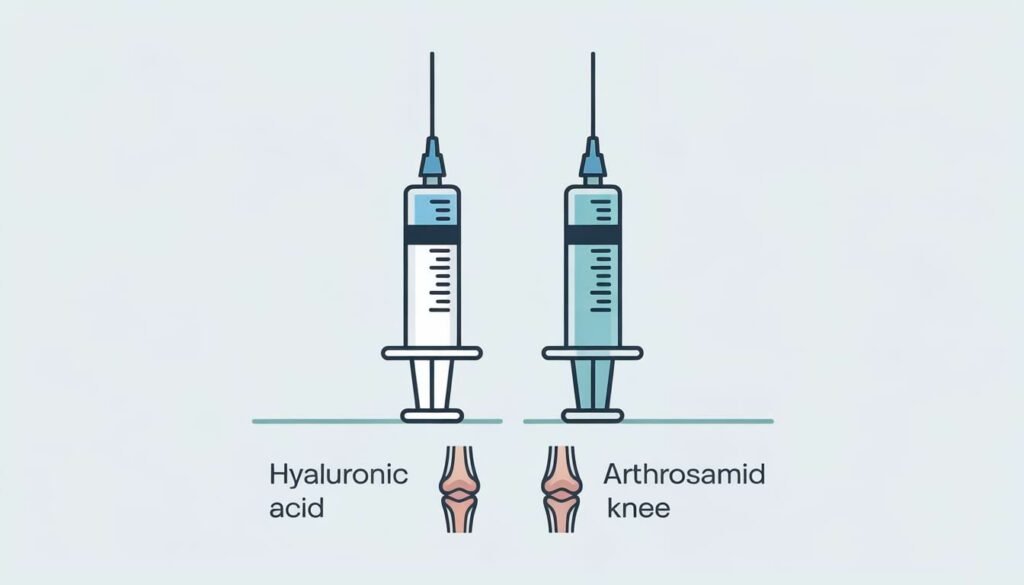
Hyaluronic acid injections — sometimes called lubricant injections or viscosupplementation — work by replenishing the natural hyaluronic acid in the joint fluid, temporarily restoring lubrication and cushioning. Brands such as Ostenil®, Durolane, and Synvisc are among the most commonly used in UK clinics.
Hyaluronic acid injections have a well-established safety record and can provide relief lasting between four and twelve months. Some patients respond extremely well and manage their osteoarthritis effectively with periodic repeat courses.
At Joint Injection UK, we offer Ostenil® hyaluronic acid injections as one of our core treatment options — particularly suitable for patients at an earlier stage of osteoarthritis or those wanting a proven, cost-effective treatment.
The key difference from Arthrosamid is this: hyaluronic acid sits within the joint fluid and is gradually absorbed and broken down by the body. This is why repeat injections are eventually needed. Arthrosamid, by contrast, integrates with the joint lining and does not degrade — making its effects considerably more durable from a single administration.
For patients who have found that hyaluronic acid injections are no longer providing sufficient or lasting relief, Arthrosamid is often the logical next step.
Arthrosamid: The Key Differences
To summarise what makes Arthrosamid distinct from other available treatments:
• It is non-biodegradable — it does not break down inside the body
• It integrates with the synovial membrane rather than simply sitting in the joint fluid
• It provides both mechanical cushioning and an anti-inflammatory effect simultaneously
• It is designed as a single-injection treatment per knee
• Clinical evidence supports benefits lasting up to three years and beyond
• It does not carry the risks associated with repeated corticosteroid use
What Are the Benefits of Arthrosamid?

For the right patient, Arthrosamid offers a genuinely compelling list of benefits:
• Long-lasting relief from knee pain, often sustained for two to three years or more from a single injection
• Improved joint function and mobility, allowing patients to return to everyday activities they had been avoiding
• Reduced stiffness, particularly first thing in the morning or after periods of rest
• A non-surgical treatment option that avoids the risks, recovery time, and downtime associated with knee replacement surgery
• Minimal disruption — the procedure is performed as an outpatient appointment and takes less than thirty minutes
• Strong safety profile, supported by over two decades of hydrogel research and clinical use
• The potential to delay or significantly postpone the need for knee surgery, giving patients more time and quality of life in the interim
For patients like David — the golfer mentioned at the start of this article — this last benefit is often the most meaningful. Arthrosamid offers a realistic bridge between where you are now and where you might need to be medically in the future.
Who Is Arthrosamid Most Suitable For?
Arthrosamid tends to produce the best outcomes in patients who:
• Have mild to moderate knee osteoarthritis confirmed on imaging or clinical assessment
• Have tried other treatments — such as physiotherapy, weight management, hyaluronic acid injections, or corticosteroids — without achieving long-lasting relief
• Want to avoid or delay knee replacement surgery, especially if they are younger or have an active lifestyle
• Are in otherwise reasonable general health with no contraindications to the procedure
• Are realistic about the timeline for improvement and committed to post-injection care and follow-up
It is not a treatment for severe end-stage arthritis where the joint has completely deteriorated — in those cases, surgery may be the only realistic option. Your specialist will be honest with you about whether Arthrosamid is likely to help based on your specific clinical picture.
Arthrosamid Injection Cost UK: What Should Patients Expect?
Cost is a legitimate and important consideration. Arthrosamid is not currently available on the NHS, which means the cost is met privately. Being transparent about this matters.
Across the UK, the arthrosamid injection cost typically ranges from around £2,000 to £3,000 per knee at reputable private clinics. Prices vary depending on the clinic’s location, the specialist’s experience, and what is included in the package (consultation, imaging, the injection itself, and follow-up care).
It is worth comparing this against the long-term cost of repeated treatments. If you are having hyaluronic acid injections two to three times per year, the cumulative arthrosamid injection cost UK over a two to three year period can begin to look comparable to what Arthrosamid offers in a single injection.
Is Arthrosamid Right for You?
Arthrosamid represents a genuinely significant step forward in the non-surgical management of knee osteoarthritis. Its unique mechanism — integrating with the joint lining rather than simply supplementing the joint fluid — sets it apart from hyaluronic acid injections and corticosteroids alike. The evidence for long-lasting benefit from a single injection is compelling, and the procedure itself is safe, quick, and minimally disruptive.
But it is not a one-size-fits-all solution. The right treatment for you depends on the severity of your arthritis, what you have already tried, your broader health picture, and what you are hoping to achieve. That is exactly the conversation we have with every patient who walks through the door at Joint Injection UK.
If you have been living with knee pain and wondering whether there is something better than the treatments you have already tried, an honest, no-obligation consultation is the most valuable first step you can take.
Book Your Consultation at Joint Injection UK

Mr Syed Nadeem Abbas and the team at Joint Injection UK are here to help you understand your options and find the right treatment for your knee pain — whether that’s Arthrosamid, hyaluronic acid injections, corticosteroid treatment, or another approach entirely.
We offer:
• Expert ultrasound-guided joint injections across all major joints
• Same-week appointments available
• Transparent pricing with no hidden fees
• Compassionate, patient-centred care from an award-winning specialist
• Treatments available for the knee, hip, shoulder, elbow, wrist, ankle, and more
📞 Call us: +44 7955 836986
🌐 Visit: jointinjectionuk.com
📅 Book a consultation today — no obligation
All treatments at Joint Injection UK are performed by a GMC-registered practitioner. Results may vary between individuals. A consultation is always required to confirm suitability before any treatment is undertaken. This article is intended for informational purposes only and does not constitute medical advice. If you are experiencing joint pain, please seek the guidance of a qualified healthcare professional.
